
bKash and Nagad money is in. Why doesn’t the till match?
bKash says the money arrived. Nagad says the same. The till and the notebook still disagree. Fees, refunds, agent cash-out, and collections on personal numbers quietly split “money in” from “books match.” Festival week makes the gap loud.
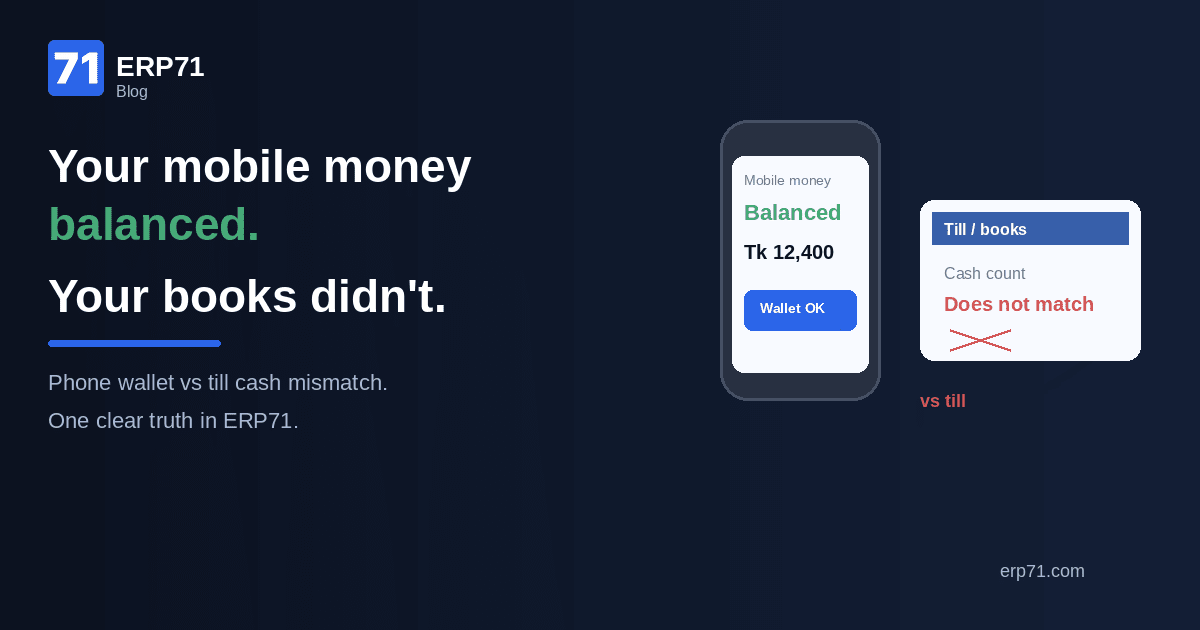
bKash says the money arrived. Nagad says the same. Your till and your notebook still disagree.
That gap shows up most on busy days — festival week, payday rush, a long Friday evening — not when the shop is quiet. Staff took digital payments all day. The phone wallets look healthy. Closing cash does not. You open SMS threads and start weekend archaeology.
This is not because your team is careless. It is what happens when cash, bKash, Nagad, and maybe a card machine each tell a partial story, and the books try to glue them together after the fact.
Why “money in” is not the same as “books match”
Mobile money feels instant. The books need a trail.
A customer pays ৳5,000 on bKash. You see a credit. What the shop actually keeps may be less after fees. A refund goes out from a different number. An agent cash-out hits the wallet but never hits the sales column. Someone collected on a personal bKash “just for today” and forgot the transfer. Each event is small. Across a month they become a mystery hole in the till.
Card settlements add another delay: the sale happened Tuesday; the bank land came later. If you booked the sale at face value and never booked the fee or the lag, month-end will fight you.
Where BD shops usually lose the thread
Fees vs net. Staff write the customer’s payment amount. The wallet received net of fee — or the fee left later. The sheet still shows gross. Every day the error compounds.
Refunds and partial returns. Money leaves the wallet. The sale line is not adjusted. Stock may also be wrong if the return was only “on the phone.”
Agent cash-out and owner withdrawals. Cash leaves digital balance for a real reason. If it is not tagged (supplier pay, personal draw, change float), it looks like missing sales cash at close.
Personal-number collections. A helper’s personal Nagad receives shop payments during a rush. Without a same-day transfer trail into the shop wallet or till, that money is invisible to the books until someone remembers — or never.
Delayed settlements. “Balance” in the app is not the same as reconciled sales for the day. Mixing them is how a green wallet and a red notebook coexist.
The painful middle
From the outside you look modern: QR codes on the counter, bKash and Nagad stickers on the glass. On the floor you are still matching SMS screenshots to a notebook or a spreadsheet tab.
Month-end becomes a hunt: which credit was which invoice, which fee belongs to which day, which personal wallet still holds shop money. You feel busy. Certainty stays thin.
If you already feel that squeeze on stock versus cash — we wrote about stockouts and overstock here — broken digital reconciliation makes the same wallet feel emptier even when sales were fine.
Four habits that close most of the gap
You do not need a perfect system tomorrow. You need a few non-negotiables.
1. Log every digital receipt against a sale the same day.
bKash/Nagad credit without a sale ID (or invoice/rough slip) is how mystery money starts. Sale and receipt should meet before the next morning.
2. Book fee vs net on purpose.
Decide one rule: record gross sale + fee expense, or record net received + note the fee. Mixing both across staff is worse than either rule alone.
3. Daily or end-of-day match: cash + bKash + Nagad (+ card) vs sales.
Fifteen minutes at close beats a Sunday of SMS digging. Write the four buckets. Compare to sales total. Investigate the same day while people still remember.
4. Personal-wallet collections need a transfer trail.
If shop money lands on a personal number, transfer to the shop wallet or till the same day and note it. No trail means no trust at month-end.
These habits work on paper. They work better when sales and settlements live in one place so a busy festival counter cannot “update later.”
When screenshots stop scaling
If your reconciliation lives in WhatsApp forwards and phone galleries, you will keep winning individual days and losing the month — the same pattern as running sales on spreadsheets after the shop outgrew them (related).
Start this week with one EOD match: cash, bKash, Nagad, sales. Name one shop wallet as official. Ban silent personal collections without a transfer note.
When memory and screenshots stop scaling, tools like ERP71 are built to keep sales and settlements together — shop-floor clarity without pretending you need an enterprise finance rollout tomorrow.